I’ve spent the last year of my life copywriting art history and making contemporary photography sales for blue chip art galleries. Here are a handful of samples of that work.
Steve McCurry – Camels and Oil Fields, 1992
Steve McCurry was born in Pensylvania in 1950. McCurry became interested in photography after taking cinematography classes at Penn State. After around two years of courses, he left for India with only $700 and 500 rolls of film. After Steve had grown sufficiently as a photojournalist, he found himself whisked away to Afghanistan where he was shooting a mujahideen camp when he was smuggled into rebel-controlled areas in Afghanistan just before the Soviet invasion in 1980. When he emerged, he had rolls of film sewn into his clothes of his remarkable images of the almost abandoned conflict.
in August of 1990, Iraqi forces lead by Saddam Hussein and impelled by longstanding border disputes in tandem with their own economic and territorial ambitions invaded neighboring Kuwait. In response to the invasion, a coalition of countries led by the US assembled to confront Iraqi forces and restore Kuwait’s sovereignty. When diplomatic efforts failed, the US declared war on Iraq in January 1991. After a massive aerial bombardment campaign and a ground offensive that quickly overwhelmed Iraqi forces, Iraqi troops made their retreat from Kuwait. As they retreated the Iraqis set all 600 of Kuwait’s oil wells ablaze.
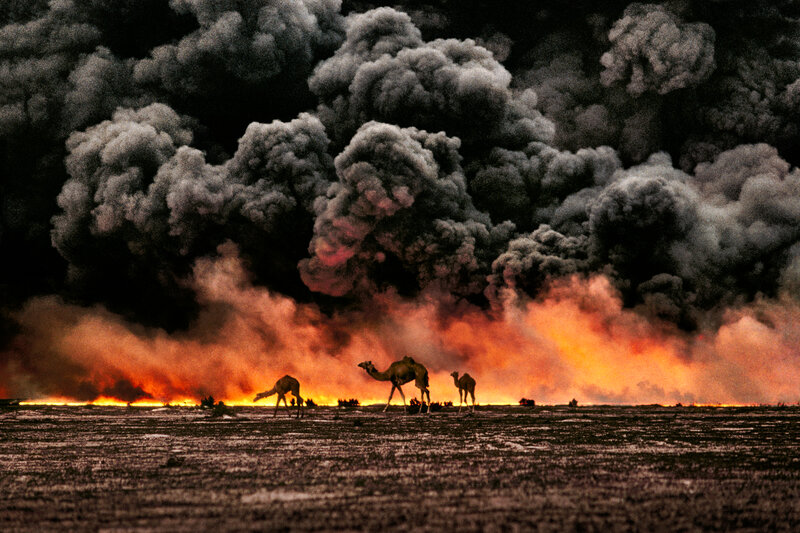
One of McCurry most evocative shots occurred in this very context, the aftermath of the first Gulf war. In this particular photograph, Camels and Oil Fields , the veiwer is transported to a haunting scene of desolation and destruction. When McCurry arrived in March of 1991, Southern Kuwait was totally dark. The scorched, barren landscape was overcome by billowing clouds of smoke emanating from burning oil wells. The moist, dense, black smoke blocked the sun during the day making it look as if it were night.
Reflecting on the scene, McCurry recalled the profound tragedy witnessed during his time in Kuwait. He described the darkness caused by the burning oil wells as akin to a moonless night, attempting to illustrate with words the pervasive sense of chaos and disfigurement that engulfed the gulf. Against this backdrop of ruination , a caravan of camels treks the dessert, in search of clean water and uncontaminated fodder, their silhouettes stark against the raging inferno.
Mccurry’s essential strategy for photography is to capture the sentient element of war. The composition of the image is deliberate and evocative. Divided horizontally into thirds. Taken from a low vantage point, the vast expanse of smoke appears endless, enveloping the entire frame in a shroud of darkness.
David Yarrow – African Tails, 2017
David Yarrow was born in Glasgow, Scotland, in 1966. He was given his flowers in the art world at a young age, working as a photographer for The London Times at the World Cup Final in Mexico City at 20 years of age, where he captured an venerated image of Diego Maradona holding the World Cup. This shot propelled him into the center of the photograhy zeitgiest and opened the door for him to cover the Olympics and a panoply of other major sporting events. Over the years, Yarrow shifted his focus to capturing not only the world of sports but to include sentient subjects and landscapes alike.
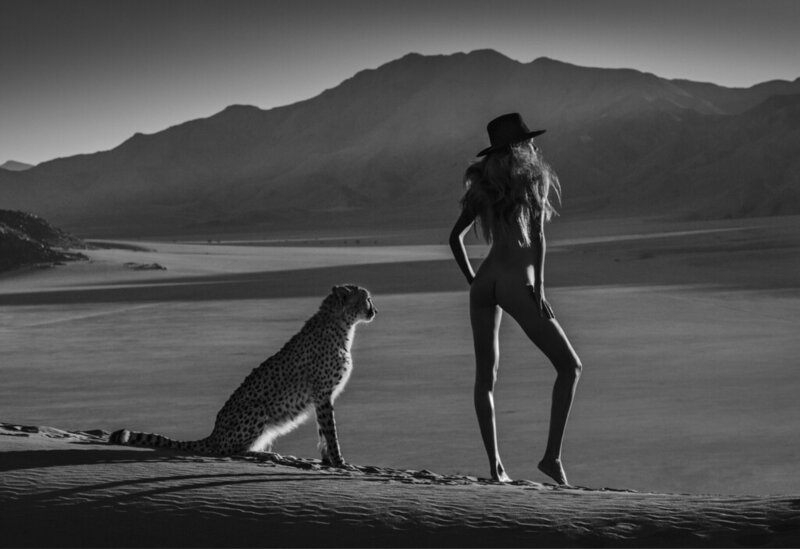
It’s a cool, dark night in the southern tip of Africa- Namibia to be exact. David is carefully packing up camera equipment and making last minute preparations for a shoot he’s been anticipating with ardent ferver. Long before the break of day, Yarrow, with crew, model, and a cheeta in tow, began the trek to a remote desert location, he had envisioned and scouted for this very moment.
As they arrived, Yarrow was delighted that the dunes were just as they were when he last left them. Even in the dark he could see the mounds had remained virginal, ridges hewn to perfection by desert zyphyrs. Every step circumspect, as to not visibly disturb the terrain, they attempted to leave not traces before the fated shot. In a race against the rising sun, model, Erica Lawrence, disrobes fully – all but her beloved widebrimmed hat while Yarrow and his crew attempts to set up the perfect shot, while contending with a strong willed feline. Luckily, Erica with her formidable presence has no problem commanding the camera. And as the sun began to rise in the east, the decisive moment arose. The shutter of the lens caught both Erica and the cheeta gazing vaguely in parallel at the horizon; What their focus is truly fixed on remains a mystery. By 7 am, the sun was up and the shoot had concluded.
Ansel Adams – Thunderstorm, Yosemite 1945 (printed 1990s)
Born in California in 1902, Ansel Adams, learned to have reverence and respect for nature at an early age. His earliest memory was watching as smoke billowed from the rooftops of smouldering buildings during the earthquake of 1906 in San Fransisco. In the aftershock, he was hurled into a wall by the movement of the earth. Subsequently a doctor found that his nose had been broken during the ordeal and it was never set straight; he breathed through his mouth for the rest of his life. Adams was a sickly, lonely, and hyperactive youth. He had few friends and was expelled from a number of schools, but he took solace in the outdoors and gazing at the stars. Ansel first visited Yosemite with his family in 1916, he was captivated by the park’s granite clif faces, vast valleys, and ever evolving waterfalls. In retrospect he wrote “the splendor of Yosemite burst upon us and it was glorious…. One wonder after another descended upon us…. There was light everywhere…. A new era began for me.” On this trip, his father gave him his first camera, an Eastman Kodak. One could say the fate of Ansel Adams, was on that day, sealed. He went on to develop into the archetypal modernist, a proponent of full range photography, and pure photography. His photos are much more than merely capturing the landscapes. He reconnoitred the landscape of seriality through the frame of time, space and motion; wielding a set of techniques to immortalize the ephemeral. Adams, through his work, evoked very real feelings from the public, mediating bond between the nature and the normal world, inviting them to experience the same sense of reverence that he felt in Yosemite’s embrace.
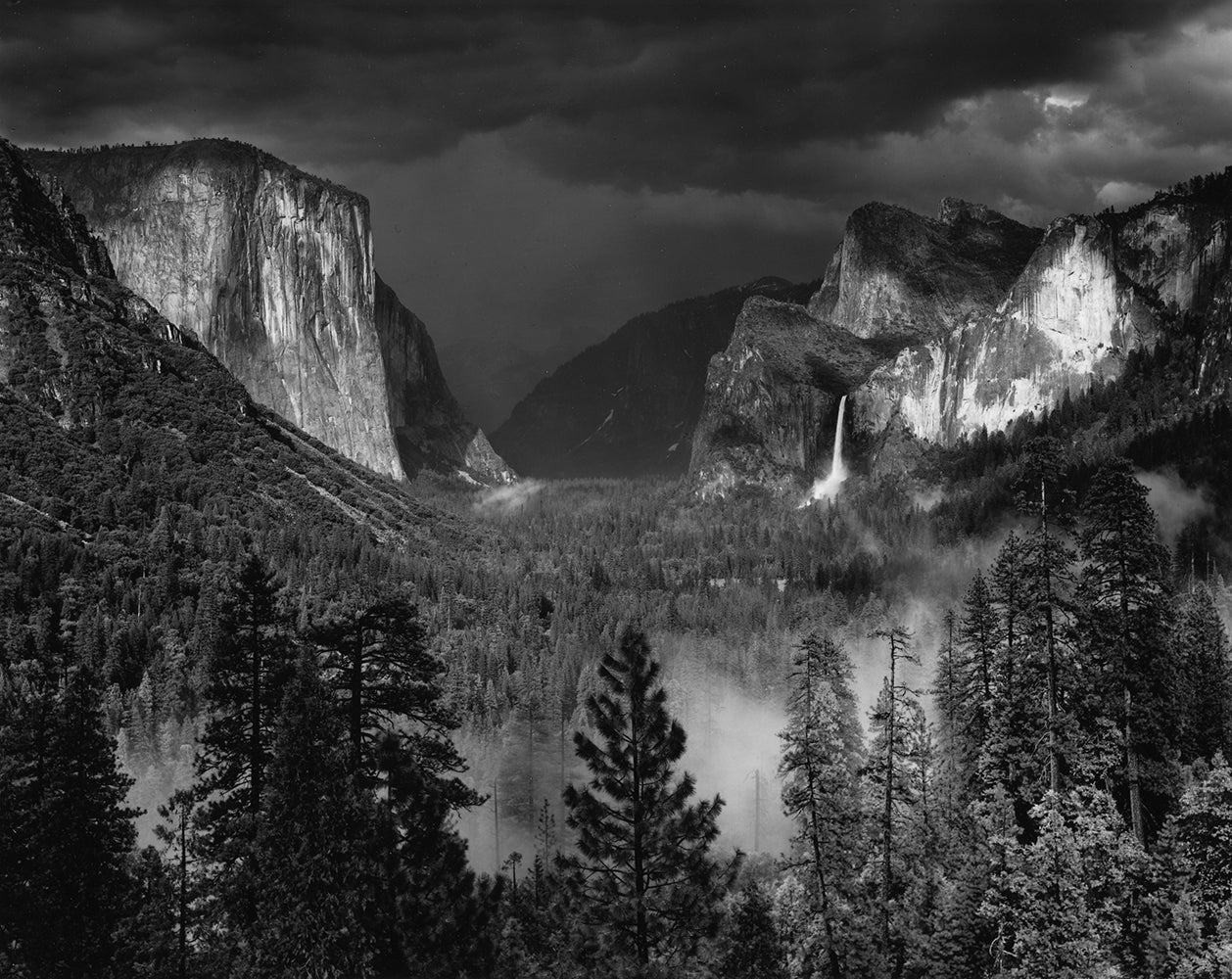
This particular image, taken in the spring of 1949, is an apt symbol for the strength, volatility, and indifference of nature that inspires Ansel’s awe. Thunderstorm proffers a keyhole perspectitve of (from left to right): El Capitano, Half Dome, Bridalveil Fall and Three Graces. Ansel Adams captured this photograph using an 8 x 10” view camera and Kodak’s Pan-X film. Employing a yellow filter, heightening the contrast to accentuate the otherworldly air of the rain battered but resilient forest nestled in the valley below. This filter darkened the sky and amplified the stark, metallic appearance of the clouds, adding to the dramatic effect of the scene.
Adams oft referred to Yosemite as his “spiritual home,” a sentiment clearly reflected in his work.
Both as a photographer and conservationist, Adams’ role in rousing the 20th century American masses to support conservation efforts of Yosemite and America’s wildlife at large, cannot be understated. Throughout his five decade career, Adams returned to Yosemite repeatedly and frequently.
Harry Benson — Beatles Pillow Fight, 1964
Harry Benson recounted his fortutitous encounter with The Beatles in 1964. Benson considers himself a ‘serious journalist’, so he was of course initially very reluctant to shift focus from undertaking a story in Uganda to photograph a newfound boy band in Paris. Out of a sudden, Benson found himself swept up in the band’s energy watching them play All My Loving at a warm-up gig in Fontainebleau. At that moment, he realized that this would be his breakthrough project and thus resolved to ‘stay close to them’. Soon thereafter, the boys were hit with the news of The Beatles’ song I Want to Hold Your Hand reaching number one on the US charts. Benson, describing this moment as the perfect confluence of factors.
Later on, when Benson heard the boys recounting the joys of a recent pillow fight, he asked to photograph them reliving the moment. John initially rebuffed the inquiry, reasoning that they’d be seen as childish. Little did they know that a childish little pillow fight in their hotel suite became a historic moment frozen in time.
Harry reflects on the uncanny composition of the photograph and recollects with fondness Paul’s role in the dynamism of the image. Paul’s pillow suspended mid air makes the photo ambulate and gives the whole tableaux flow. The photograph, capturing the playful pillow fight with Paul swinging at John, while John swings on George, and Ringo jumps on George, stands out among the snapshots Benson took that night. Though, even Benson didn’t know just how influential the photo would be as he developed the film on the toilet seat of his hotel bathroom turned impromptu dark room and sent them back to Loondon.
This single image catapulted Benson’s career into the ether of the entertainment industry, leading to an extended collaboration with The Beatles during their first US tour. The way Benson puts it, he believes he captured The Beatles at the height of their camaraderie and creativity.
In Benson’s own words, “Some assignments I feel I could go back and improve on, but not The Beatles, I don’t think I could have bettered it.” He’s confident in having seized the perfect moment that won’t ever be replicated. The photograph remains a testament to Benson’s impeccable timing and his ability to immortalize an intimate and playful side of the legendary band during their early years.
As part of a larger eovre capturing intimate moments of the 20th century’s most prominent figures, Benson’s photograph of The Beatles serves as a timeless relic of an era when the band was still fresh and the chemistry among its members was palpable.

Robert Doisneau – Le Baiser de L’Hotel de Ville, 1950
During World War II, Robert Doisneau was both a soldier and photographer, documenting wartime France. Doisneau truly came to promince capturing the essence of everyday life on the streets of Paris; Le baiser de l’hôtel de ville is the archétype for this approach.
Originally commissioned for a LIFE magazine spread, following its initial publication, but the photo seemed to vanished inexplicably for over three decades, only to resurface in 1986 when the publication decided to market it as a poster. The picture’s success was meteoric, with Le baiser de l’hôtel de ville becoming a global sensation. Though it lacks the grandeur of some other iconic photos, It’s sold over half a million copies. This image has managed to become a dorm room staple since its debut in 1986. Yet Doisneau, ever the discerning artist, was ambivalent about the photo’s widespread appeal. He attributed its universal appeal to an easy effect, musing “This success shows that it is an easy effect. Why do so many people identify with this photo? Because it is the symbol of a happy moment.”
In tamdon with the picture’s popularity, controversy arose. A panoply of pairs asserted that they were the couple featured therein and claiming royalties. In 1992, a couple, the Lavergnes, claimed to be the long lost subjects of the iconic kiss and suing on the grounds of a privacy violation. Then came Françoise Delbart, holding the original signed photograph, revealing herself to be one of the anonymous lovers from 1950. The suits culminated in the Paris High Court dismissing the Lavergnes’ claim, citing a lack of substantiating evidence, and Delbart’s inability to claim image rights due to her face not being visible.
Fascinatingly, when Françoise sued Doisneau in 1993. She claimed that she and her at-the-time partner Jacques Carteaud, who were studying theater at the moment, had been contacted by Doisneau for the shoot. He proposed a staged yet deeply romantic photo session, offering the couple 500 francs as compensation. Doisneau was forced to admit that the shot had indeed been staged, adding “I would have never dared to photograph people like that. Lovers kissing in the street, those couples are rarely legitimate.”
In the end, Françoise decided to auction the original print in 2005 through the Artcurial auction house. The transaction proved monumental, fetching a staggering sum of 185,000 euros, attesting to the enduring cultural and historic significance of the photograph.
Authentic or not, “The Town Hall Kiss” stands as a quintessential representation of Doisneau’s signature style throughout his illustrious career; a tender, nostalgic embrace captured in black and white.

Ruth Orkin – A Girl in Italy, 1951
Ruth Orkin met Ninalee Lee Craig in Florence in 1951 when they were both 23. This was during a time when spotting American travellers in Europe was unheard of let alone unaccompanied female travellers. Bonding over shared passion for solotravel, Orkin proposed a photo shoot she’d been conceptualizing for years. She sought to capture the experience of a woman alone in the streets of europe and now she had her ideal subject in tow.
Ruth fondly recalled the decisive moment writing “We were having a hilarious time when this corner of the Piazza della Repubblica suddenly loomed on our horizon,”
This particular photo, portraying Craig traipsing through a hoard of oggling men on the streets of Florence, was is part of a larger series that was published in Cosmopolitan in 1952. It challenged gender norms of the era. The series includes scenes from Paris and Venice. The images, accompanied by a photo essay titled “Don’t Be Afraid to Travel Alone.” , which provided tips ‘men, money, and morals’ and reflected the progressive notion of encouraging solo female travel during that time.
The enduring question surrounding the iconic photo of Ninalee immortalized in Ruth Orkin’s “An American Girl in Italy,” revolves around its authenticity. At 89, Craig steadfastly maintains that this captivating scene of her parting a mass of men as if they were the red sea is indeed authentic. Conversely, Orkin later penned that she had long envisioned the scene. It’s reasonable to believe that they’re both telling the truth as far as they perceived the events.
The second most common inquiry, asto whether she felt fear or discomfort during this seemingly perfect moment, evokes a resolute ‘No’ from Craig. Rather, she exclaims “I was Beatrice walking through the streets of Florence. I felt that at any moment I might be discovered by Dante himself.”
Craig & Orkin’s photograph has long been a lady’s dormroom linchpin, fostering discussions on feminism and street harassment long before the nomenclature to decribe the phenomena entered the zietgiest; But the image has remained in vogue and even increased in popularity as it’s message is more resonant than ever, symbolizing independence, freedom, and self-determination.

 Fanta Kouyate